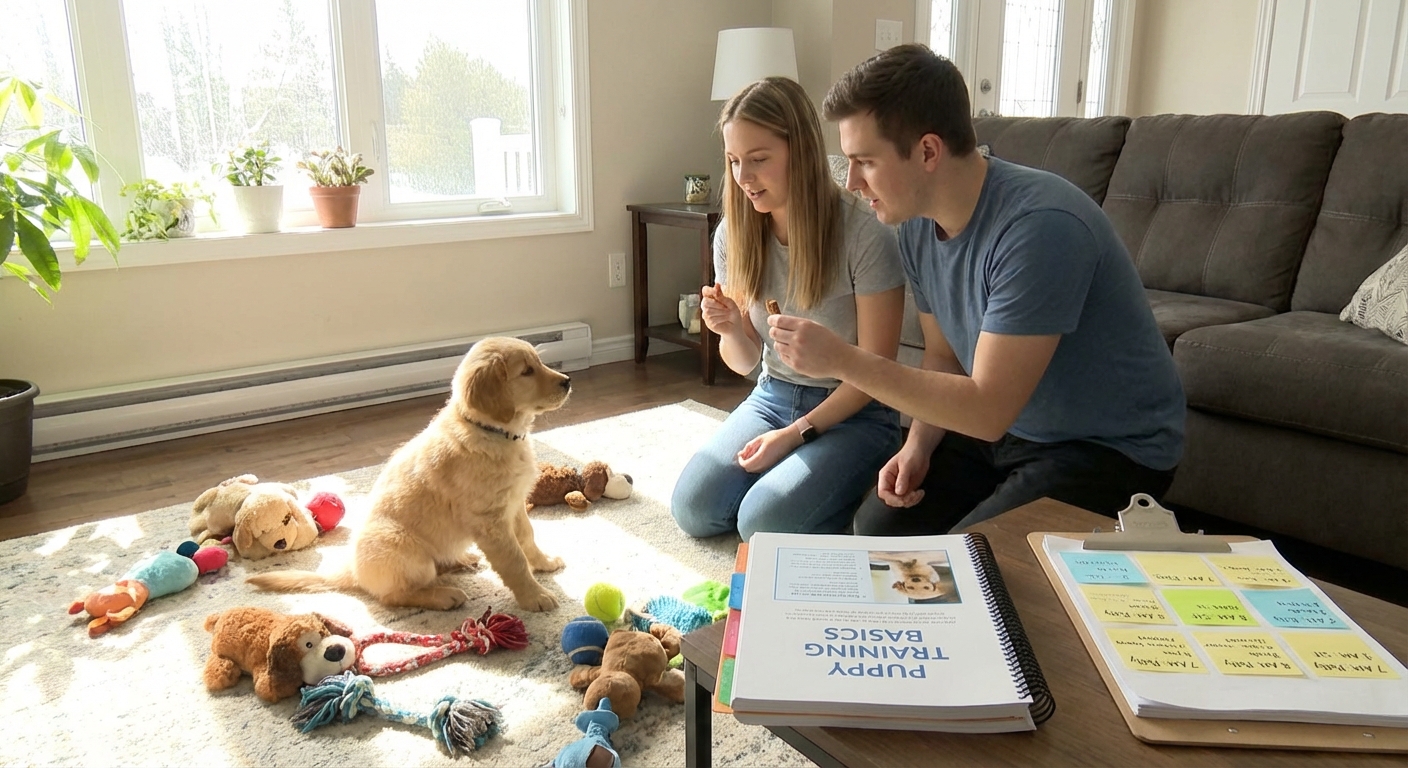
Modern canine behavior research consistently supports positive reinforcement as the most effective and humane way to train dogs. It builds trust, reduces fear, and helps puppies learn faster.
Training with Heart and Science
This blueprint shows you how to use reward-based training to teach manners, prevent problem behaviors, and nurture a confident, happy puppy.
The Learning Basics (In Simple Terms)
Puppies learn mainly through consequences:
- Behaviors followed by good things (treats, praise, play) happen more often
- Behaviors that don’t lead to rewards fade over time
Instead of punishing what you don’t like, focus on shaping what you do like.
Your Training Toolkit
- Soft, pea-sized treats (or part of their meal)
- A marker: a clicker or a word like “Yes!”
- A 6-foot leash
- A comfy harness
- A quiet space with few distractions
Step 1: Build a Reward System
Charge Your Marker
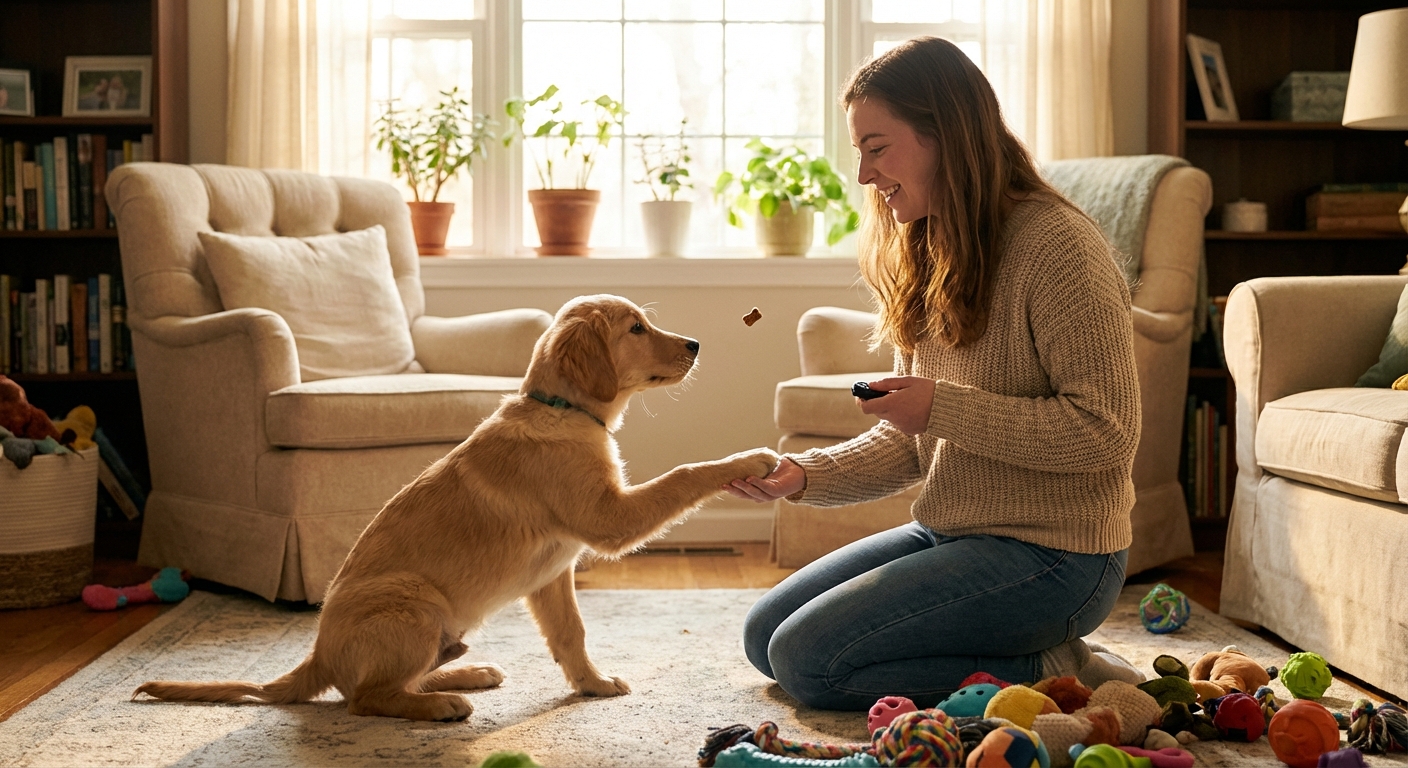
- Say your marker word (“Yes!”) or click.
- Immediately give a treat.
- Repeat 10–15 times.
Your puppy learns that marker = reward is coming.
Choose High-Value Rewards
Have a mix of:
- Everyday rewards: kibble, simple biscuit treats
- Jackpot rewards: bits of boiled chicken, cheese (in moderation), or commercial training treats
Use better rewards for harder tasks or distractions.
Step 2: Essential Early Skills
Short, frequent sessions (3–5 minutes) are ideal.
Name Response (The Foundation)
- Say your puppy’s name once.
- When they glance at you, mark (“Yes!”) and treat.
- Repeat 10–20 times over the day.
Goal: Your puppy snaps their head toward you when they hear their name.
Sit
- Hold a treat at your puppy’s nose.
- Slowly move it up and back over their head.
- As their bottom touches the floor, mark and treat.
- Add the word “Sit” once they offer the behavior reliably.
Down
- Ask for a sit.
- Bring a treat down to the floor between their front paws.
- Slowly move the treat out along the ground.
- As they lie down to follow, mark and treat.
If they stand up, reset and try again, moving the treat more slowly.
Step 3: Recall (Come When Called)
A reliable recall can keep your puppy safe.
Indoor Foundation Game
- Start in a quiet room.
Kneel down, open your arms, and cheerfully say, “Puppy, come!”
3. When they move toward you, mark and give 3–5 tiny treats in a row. 4. Release with a happy “All done!” and let them wander away.
Practice with different people calling in turn, always making coming to you feel like a party.
Leveling Up
- Move to slightly more distracting rooms
- Then fenced yards on a long line (10–30 ft leash)
Avoid calling your puppy for things they dislike (e.g., nail trims) at first; you want that word to always predict good things.
Step 4: Loose-Leash Walking
Pulling is natural for puppies; they move faster than we do. Teaching loose-leash walking is about rewarding the position you like.
Getting Started Indoors
- Clip on a harness and leash.
- Hold the leash in one hand and treats in the other.
- Take a step; if the leash stays loose and your puppy is near your side, mark and treat.
- After a few successful steps, reward every 2–3 steps, then every 4–5.
If your puppy forges ahead and the leash tightens:
- Stop moving.
- Wait silently.
- When they turn back or the leash slackens, mark, reward at your side, and move again.
Consistency teaches: tight leash = no progress, loose leash = we walk and get goodies.
Step 5: Preventing Common Problem Behaviors
Jumping on People
Puppies jump because it works—they get attention.
Instead:
- Ignore jumping: turn your body away, no eye contact or talking.
- The moment all four paws are on the floor, mark and reward.
- Ask for a sit before greeting.
Over time, your puppy learns that calm = affection, jumping = nothing happens.
Mouthing and Biting
Teething and play-biting are normal, but we can guide them.
- Keep puppy-safe chew toys available.
- When your puppy mouths skin:
- Say a calm “Ouch,” then immediately redirect to a toy.
- Praise when they chew the toy.
- If they escalate, briefly pause play (10–20 seconds), then resume.
Avoid rough wrestling games that encourage biting hands or clothes.
Chewing the Wrong Things
Chewing helps with stress relief and teething.
- Puppy-proof: remove access to shoes, cords, remote controls.
- Rotate a few chew toys to keep them novel.
- Praise and treat when your puppy chooses their own toys.
- Offer a better treat or toy.
- Say “Drop it” as they release, then reward.
If they grab something off-limits, trade up:
Socialization as Training
Socialization is about positive, controlled experiences with people, animals, environments, and sounds.
The “S.A.F.E.” Socialization Rule
- Short: keep new experiences brief at first
- Appropriate: match intensity to your puppy’s comfort level
- Fun: pair with treats, play, gentle praise
- Exit available: let your puppy move away if overwhelmed
- Reward calm interest in new people and dogs
- Avoid forcing greetings if your puppy seems unsure
- Introduce umbrellas, hats, bikes, and strollers gradually
Bring treats on walks and:
Helpful Training Products
- Clicker (Karen Pryor i-Click or similar): clear, consistent marker
- Treat pouch (e.g., Kurgo or PetSafe): keeps rewards handy
- Harness: front-clip no-pull harness (Ruffwear Front Range, 2 Hounds Freedom) for gentle control
- Long line: 15–30 ft line for safe recall practice
Choose comfortable, well-fitted gear; training should never rely on pain or fear.
Tracking Progress and Staying Patient
Keep a simple training log:
- List 3–5 cues you’re working on
- Note difficulty (1–5) and distractions
- Celebrate small wins, like “Looked at me instead of chasing the leaf!”
Expect ups and downs—fear periods and growth spurts can temporarily disrupt progress. This is normal.
When feeling stuck:
- Make the task easier (less distraction, shorter distance)
- Use higher-value rewards
- Shorten sessions and end on a success
If you’re overwhelmed, consider a force-free puppy class led by a credentialed trainer (look for CPDT-KA, KPA-CTP, or similar)
Training as a Love Language
Positive reinforcement training is more than teaching cues—it’s how you tell your puppy, “You’re safe. I see you. I’ll guide you kindly.”
With patience, consistency, and rewards your puppy loves, you’re not just raising a well-behaved dog; you’re building a lifelong partnership based on trust.
Key Takeaway
The most important thing to remember from this article is that this information can change how you think about Puppy Care.